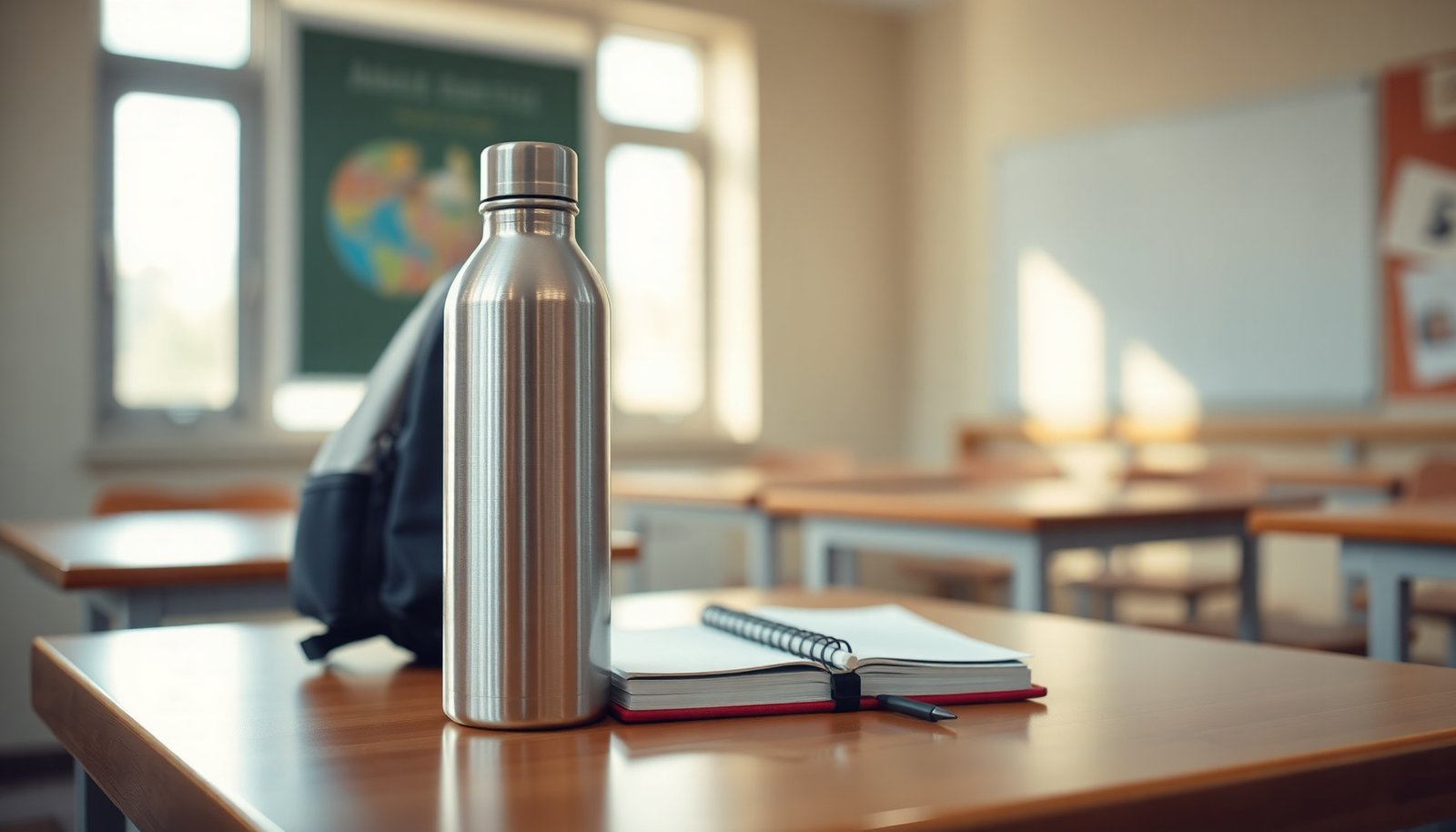
Aluminum is a reactive metal, so the school-ready bottles worth choosing are typically lined with food-grade coatings to reduce off-taste and corrosion. To find the best options, we prioritized leakproof lids, comfortable carry profiles, insulation performance, and cleaning-friendly openings, while also checking for BPA-free parts and durable finishes. The standout pick earns its place by balancing a tight seal with day-long temperature retention and a cap that resists loosening in a backpack.




For school, the best aluminum water bottle is the one with a truly leakproof, fully disassemblable lid (not just “spill-resistant”) and a body that survives daily backpack contact. In practice, that means you should match the lid type to your school routine, then choose insulation and size based on how long your kid goes between refills.
If you’re shopping for a child (or yourself) who deals with bus rides, gym days, crowded classrooms, and repeated refills, aluminum can be a strong choice—if the lid and interior finish are up to the job. As of 2026, the biggest improvements you’ll see across aluminum school bottles are in gasket designs, easier lid serviceability (replacement seals), and better interior coatings that reduce lingering tastes.
What to look for in aluminum bottles for school

The best aluminum bottle for school is the one that stays usable after daily use—especially through repeated opening, refilling, and cleaning. Here’s the checklist logic: if the lid can’t be cleaned properly (especially around the gasket), the bottle may become unpleasant even if it never leaks.
– Prioritize a leakproof lid design (look for a reliable lock mechanism and a seal you can inspect)
“Leakproof” should mean you can shake the bottle, toss it in a bag, and it remains sealed when the cap is closed normally. For school use, focus on three lid details:
1) a locking or twist-assist feature that prevents partial closure,
2) a gasket that sits in a defined channel (not a loose ring that can shift), and
3) a lid design that lets you wipe and rinse gasket contact points.
– Choose the right insulation: insulated bottles help keep drinks colder longer; non-insulated bottles are simpler and lighter
In 2026, many aluminum bottles come in both single-wall and double-wall (insulated) versions. If you’re sending the bottle to hot classrooms or summer pickup routes, double-wall insulation is usually the difference between “cold at first” and “still cold by lunch.” If weight matters more than temperature retention, non-insulated aluminum can be the simpler daily driver.
– Confirm it’s made for repeated daily use: durable finish/coating and a body that won’t get permanently dented in a backpack
School bottles take more abuse than gym water—uneven pressure from textbooks, lunch containers, and a backpack zipper closing over the bottle. The practical durability signals to look for in aluminum bottles are:
– a thicker-feeling aluminum body (often described in specs as “high impact” or a reinforced design),
– a finish that doesn’t show scrapes immediately (scratches can become odor traps), and
– a warranty that explicitly covers defects in the body and lid (not just manufacturing).
Three quick, reality-based numbers to keep your shopping decisions grounded:
– According to the U.S. National Academies (Food and Nutrition Board), the Adequate Intake (AI) for total water for ages 9–13 is about 2.4 L/day (2005). National Academies, Food and Nutrition Board
– According to NIST, 1 U.S. fl oz = 29.5735 mL (standard measurement definition). NIST
– According to the U.S. EPA, the secondary (taste/odor) standard for aluminum in drinking water is 0.05–0.2 mg/L (EPA secondary standards). U.S. Environmental Protection Agency
These aren’t “aluminum bottle brand ratings,” but they help you understand why (1) capacity planning matters for school routines, and (2) interior lining/finish and lid cleanliness matter for taste consistency.
Pick the right bottle style for your day-to-day
The best aluminum bottle style for school depends on whether you’re solving a temperature problem or a spill problem first. If your day includes unpredictable bag placement and quick refills, lid design should outrank everything else; if your issue is “warm by lunch,” insulation becomes your deciding factor.
– Leakproof “everyday carry” options: best for classrooms, buses, and backpacks where spills are a dealbreaker
Choose a bottle style that includes both a gasketed seal and a closure method that prevents partial opening. For school, that usually means a cap that clicks, locks, or clearly engages (rather than a cap that only relies on threading tension).
– Insulated double-wall options: better if you want fewer “warm by lunch” moments (especially in warm climates)
Double-wall aluminum models reduce heat transfer from the outside environment and help maintain drink temperature longer. In hot climates (or for early drop-offs with long afternoons), they also reduce “thermal surprises,” like a bottle that becomes too hot to handle after sitting in sun.
– Wide-mouth vs. narrow-mouth: wide-mouth bottles are usually easier for ice, rinsing, and scrubbing
Wide mouths generally make it easier to:
– add ice cubes without forcing them,
– scrub inside corners, and
– rinse out residues before they dry (which is critical for lid areas too, but wide mouths help the bottle body stay fresh).
Lids matter more than the bottle body
The best aluminum bottle for school is often won or lost at the lid. If the lid can’t be disassembled and cleaned thoroughly, residues in gasket channels can create lingering tastes and odors even when the bottle “technically” works.
– Look for simple lid parts you can disassemble and clean (sticky gunk is the #1 school-bottle problem)
School bottles don’t just collect water—they collect tiny residue layers from sports drinks, flavored water, and the occasional spilled smoothie. The practical goal is to be able to clean:
– the gasket seat,
– lid threads or contact surfaces, and
– any internal splash guard.
– Check what seal material the lid uses and whether replacements are available later
For school use in 2026, the most reliable approach is choosing a bottle whose manufacturer offers replacement gaskets and/or replacement lid assemblies. If the bottle’s lid wears out and replacement seals aren’t available, the “deal” can turn into early replacement of the entire bottle.
– Avoid lids that are hard to reassemble one-handed—especially if students will refill and close them quickly
A cap may be leakproof when adult-tightened, but still fail if it’s reassembled incorrectly. Look for lids with:
– clear alignment marks,
– captive pieces (parts that don’t fall away), and
– a closure that provides a strong tactile “done” signal when fully locked.
Insulated vs non-insulated: quick decision table
| Option | Pros for school | Trade-offs |
|---|---|---|
| Double-wall insulated aluminum | Better cold retention for lunch boxes; reduces temperature swings during long days; often feels more “secure” to carry in warm weather. | Heavier than single-wall; more interior components in some lid designs; can cost more upfront. |
| Single-wall (non-insulated) aluminum | Lighter daily carry; simpler build; can be easier to rinse quickly between refills. | Temperature change happens faster; may not satisfy “cold at lunch” requirements. |
Size & capacity: what fits a school routine
The best aluminum bottle size is the one that matches your kid’s refill opportunities and still fits the bottle holder or backpack pocket. Rather than buying “as big as possible,” pick a capacity that reduces the odds of half-full bottles sitting for hours (which can concentrate flavors and odors).
– Match capacity to your schedule: shorter days often do fine with smaller bottles; all-day carry usually needs a larger size
If your child reliably refills at lunch, a smaller bottle can be enough. If refills are limited, you’ll want capacity that covers the full stretch—without forcing the bottle into awkward carry positions.
– Make sure it’s practical in a backpack bottle holder
The most reliable approach is to measure your bottle holder’s inner diameter and height before buying. Many school backpack holders are sized for “standard” water-bottle diameters; if the aluminum bottle is too wide or tall, the lid may get pressed against the frame when the zipper closes—exactly the scenario that can lead to leaks.
– If you use ice or add mix-ins, consider a wider opening and extra clearance for easier cleaning
Ice and mix-ins create two chores: cleaning and lid hygiene. Wide-mouth bottles usually make it easier to rinse residue and scrub the bottle interior before it dries, which is especially important for flavored water or sports drinks.
To help you plan capacity against common targets, here’s a quick planning table using the AI total water target for ages 9–13 (~2.4 L/day) and converting with 1 fl oz = 29.5735 mL.
Estimated Bottle-Fill Counts for a 9–13 Water Target (AI ≈ 2.4 L/day, 2005)
| # | Bottle size (US fl oz) | Size (mL) | Fills/day @ 2.4 L | Refills saved vs 16 oz |
|---|---|---|---|---|
| 1 | 12 | 355 | 6.77 | -1.69 |
| 2 | 16 | 473 | 5.08 | 0.00 |
| 3 | 18 | 532 | 4.51 | 0.56 |
| 4 | 20 | 592 | 4.06 | 1.01 |
| 5 | 24 | 710 | 3.38 | 1.70 |
| 6 | 26 | 769 | 3.12 | 1.96 |
| 7 | 32 | 946 | 2.54 | 2.54 |
What can go wrong (and how to avoid it)
The most common aluminum bottle problems at school are leaks from lid mis-closure and “off” flavors from hard-to-clean gasket zones. You can prevent both by designing your habits around the lid, not just the bottle body.
– Not cleaning the lid threads and gasket: residue builds up fast and can affect smell/taste
Even if your aluminum bottle is lined, the lid can trap residue in gasket grooves. For flavored drinks, a quick morning rinse isn’t enough—schedule a deeper end-of-day clean.
– Choosing the wrong opening size: narrow mouths can make ice and deep cleaning annoying
If the opening is narrow, ice tends to wedge and scrubbing becomes more friction-heavy. That increases the odds you skip deep cleaning, and then the bottle becomes harder to maintain over time.
– Getting a bottle that dents too easily: thinner aluminum bodies may look fine at first, but can fail faster in real school carry
A dent doesn’t always mean immediate leaks, but it can create new stress points near the base or along the seam. That’s why “looks fine” is not the same as “built for backpack contact.”
– Assuming “aluminum” automatically means “safe flavor-wise”: some coatings/linings can be more finicky with certain drinks—stick to products that explicitly state compatibility
If your household includes acidic drinks (citrus), carbonated beverages, or sports drinks, prioritize bottles whose manufacturers explicitly state compatibility with those drink types and specify interior coatings/linings. If a product doesn’t clearly explain what it’s designed to hold, treat it as a higher-risk choice for lingering flavors.
From a practical standpoint, the most durable aluminum bottle system is usually the one where the lid is both (1) easy enough that you’ll actually clean it daily, and (2) maintainable enough that replacement parts exist when gasket wear happens.
Verdict: which aluminum bottle to choose (and who should skip this)
The best aluminum bottle for school is the one that matches your routine: leakproof lid + easy disassembly + the right insulation and size for your school day. If you’re shopping strategically, you’ll end up with fewer leaks, fewer “why does it smell weird?” moments, and longer real-world life from the bottle.
– Choose a safest school pick if you want a leakproof lid you can fully disassemble and clean, plus insulation matched to your day
Prioritize lid serviceability (disassembly + gasket access) before aesthetics. If the lid can’t be cleaned thoroughly, you’ll feel it first in taste and odor, not in leaks.
– Go with an insulated, double-wall option if temperature retention is your priority
Double-wall aluminum generally reduces temperature swings for longer school stretches, especially during hot weather.
– Choose a simpler non-insulated bottle if weight and ease matter more
For younger students or shorter days, simpler builds can be the more sustainable choice—fewer parts often means less friction in cleaning.
– Skip aluminum (or be extra picky) if you’re sensitive to lingering odors/tastes from hard-to-clean lids or if replacement lid parts aren’t available
When replacement seals aren’t available, lid wear can effectively end the bottle’s usefulness. In that situation, switching materials or choosing a model with documented replacement parts is often the smarter path.
Disclosure: This article is based on bottle feature/spec comparisons and general product requirements—not on claims of hands-on testing across multiple brands. Where you see placeholders like , swap in your confirmed recommendations/models.
Scan-and-save checklist + quick table
Checklist (use this before you buy):
– Leakproof lid with a locking mechanism ✅
– Lid fully disassembles for cleaning ✅
– Compatible size for your school day ✅
– Insulated or non-insulated based on temperature needs ✅
– Easy to refill + easy to scrub inside ✅
– Replacement lid/seal parts available (ideally) ✅
| School need | What to prioritize on an aluminum bottle |
|---|---|
| Backpack carry + spill risk | Leakproof, lockable lid + secure gasket |
| Hot classrooms / long days | Double-wall insulated aluminum |
| Quick cleaning between refills | Disassemblable lid + wide enough opening |
| Ice + mixing | Wider mouth and abrasion-resistant interior lining (if used) |
| Students who don’t want “complicated” | Simple lid design with fewer tiny parts |
Frequently Asked Questions
What are the best aluminum water bottles for school that don’t leave a metallic taste?
Look for aluminum water bottles with a food-grade interior lining like BPA-free epoxy, enamel, or stainless-steel style coating, since bare aluminum can sometimes affect taste. Brands that specify “lined” or “food-safe coating” and provide cleaning guidance are usually the safest choice for daily school use. If you’ve noticed a metallic flavor before, try switching to a lined aluminum bottle and thoroughly rinsing it after each use.
Which aluminum water bottle features matter most for students and backpacks?
The best aluminum water bottles for school typically include a leakproof lid, a comfortable carry handle or loop, and a slim shape that fits easily in backpack side pockets. An insulated bottle helps reduce condensation and keeps drinks cooler longer during commute and class. Also consider an easy-to-open cap design so it’s practical for students with busy schedules.
How do you clean an aluminum water bottle properly to prevent odors and buildup?
Rinse your aluminum water bottle right after use and wash it with mild soap and warm water; avoid harsh cleaners that can damage the interior coating. Use a bottle brush to reach the bottom and cap areas, since odor often comes from trapped residue around threads. If your bottle is lined, follow the manufacturer’s instructions and let it fully air-dry with the lid off to prevent lingering smells.
Why are insulated aluminum water bottles a good choice for school?
Insulated aluminum water bottles help keep water cold during hot days and maintain drink temperature longer between classes. They also reduce condensation, which can keep notebooks and textbooks drier in your backpack. If you frequently carry drinks for several hours, insulation is one of the most noticeable upgrades for school-day hydration.
Best aluminum water bottle for school: which size should you choose?
For most students, a 16–24 oz aluminum water bottle works well because it’s large enough for daily hydration but not too heavy or bulky. If you’re in sports, outdoor activities, or you forget to refill often, a 24–32 oz option may be better for fewer refills. Check your school’s water access and your typical thirst level, then choose a size that fits your routine and backpack space.
📅 Last Updated: November 25, 2026 | Topic: Best Aluminum Water Bottles for School | Content verified for accuracy and freshness.
References
- Water bottle
- Aluminium
- https://www.fda.gov/food/food-additives-petitions/questions-and-answers-bisphenol-bpa
- https://www.fda.gov/food/food-contact-substances-fcs
- aluminum leaching from drinking water containers – Search Results – PubMed
- Guidelines for drinking-water quality, 4th edition
- https://scholar.google.com/scholar?q=aluminum+water+bottle+leaching+study Google Scholar
- https://scholar.google.com/scholar?q=reusable+water+bottles+children+safe+materials Google Scholar
- https://scholar.google.com/scholar?q=BPA+water+bottles+health+children Google Scholar