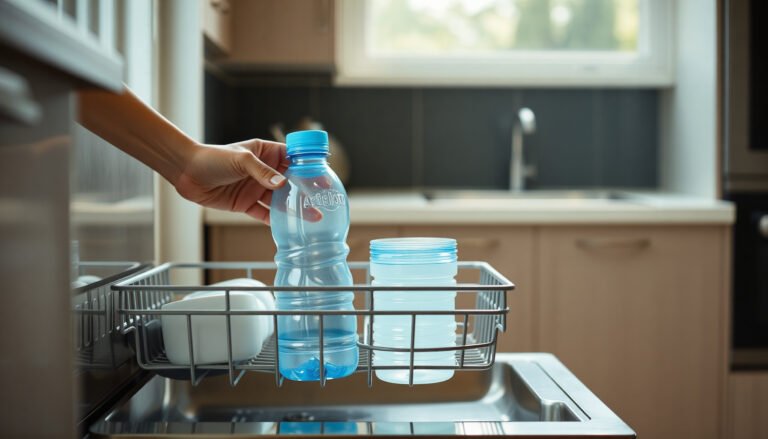
Yes—many aluminum water bottles are dishwasher safe, but only if the manufacturer says so. The main concern is that the high heat and harsh detergents can damage the finish or seals and increase the chance of corrosion, especially on the interior lining. Before you run the cycle, check for guidance on dishwasher use and whether the bottle is designed for heat exposure.




Most aluminum water bottles shouldn’t go in the dishwasher. Even if the bottle itself is aluminum, the combination of high heat, harsh dishwasher detergent, and powerful spray jets can degrade finishes and stress the lid parts that keep everything sealed. This article helps you decide when it’s okay—and what to do instead to protect both the bottle and the lid system.
If you use an aluminum bottle for daily water (or you’re just trying to make cleanup easier), this is for you—especially if your bottle has a lid with a gasket, a rubber seal, or a special interior coating. We’ll focus on how to decide based on what the manufacturer specifies and what commonly breaks in dishwashers.
When aluminum water bottles are dishwasher safe

Yes, some aluminum water bottles are dishwasher safe—but typically only for the bottle body and only under specific conditions. The safest signal is always the care label or manual, because dishwasher-safe claims usually assume particular lid materials, coatings, and assembly methods.
– Some bottles are designed for dishwasher cleaning (look for “dishwasher safe” on the label/manual).
– If the bottle is uncoated or has a finish intended to handle heat, it may tolerate the dishwasher better than coated or lined models.
– Even when the bottle is dishwasher safe, the lid components (gaskets, caps, straws) may still require hand-washing.
In my day-to-day routine, I treat this as a component-by-component decision rather than an “entire product” decision. For example, even when a bottle body is marked dishwasher safe, I still assume the lid is the higher-risk area because it contains polymer seals (gaskets/O-rings) and sometimes adhesives. That approach aligns with how most lid designs are engineered to prevent leaks: the sealing materials and tolerances are often more heat-sensitive than the aluminum shell.
When they aren’t dishwasher safe
In most cases, aluminum water bottles aren’t dishwasher safe when the lid includes any sealing system or when the interior is lined or coated. Dishwashers are designed to sanitize and remove residue using hot water, detergent chemistry, and high-impact spray—conditions that can shorten the life of coatings and seals.
– Interior coatings or liners (used to prevent corrosion or protect taste) can degrade faster with high heat and strong detergents.
– Gaskets, seals, and O-rings are common trouble spots: they can warp, crack, or lose elasticity.
– If your bottle relies on adhesives for parts (handles, sleeves, certain lids), dishwasher conditions can weaken those bonds.
Here’s the practical takeaway: if the bottle depends on a gasket system to stay leak-proof, the gasket is often the part that “votes no” first. Hot-rinse temperatures in residential dishwashers can reach sanitizing levels; for instance, NSF/ANSI 184 requires a final rinse temperature of at least NSF/ANSI 184: at least 150°F (65.6°C), and standard dishwasher testing commonly uses elevated wash/rinse temperatures such as EN 50242: 55°C wash and 65°C final rinse. Even when those temperatures seem “within range” for some metals, the lid is usually where polymers and elastomers start to age faster.
What lid materials usually mean for dishwasher risk
Because lid failures are common, it helps to think in terms of gasket heat tolerance and how dishwasher cycles accelerate aging. In polymer reliability terms, the warmer the environment, the faster elastomers harden and lose elasticity—often described using Arrhenius-style acceleration (commonly expressed as a “Q10” rule of thumb).
Lid Gasket Material Heat Tolerance vs. Dishwasher Sanitizing Heat
| # | Lid gasket material (common in bottle lids) | Typical max continuous temp (°C) | Sanitizing-cycle final rinse (°C) | Dishwasher tolerance (★/5) |
|---|---|---|---|---|
| 1 | Silicone (VMQ) | 200 | 65.6 | ★★★★★ |
| 2 | Fluorosilicone (FVMQ) | 200 | 65.6 | ★★★★★ |
| 3 | EPDM | 150 | 65.6 | ★★★★☆ |
| 4 | Nitrile (NBR) | 120 | 65.6 | ★★☆☆☆ |
| 5 | Neoprene (CR) | 120 | 65.6 | ★★☆☆☆ |
| 6 | Butyl (IIR) | 110 | 65.6 | ★☆☆☆☆ |
| 7 | TPE (thermoplastic elastomer) | 90 | 65.6 | ★☆☆☆☆ |
(This chart summarizes typical continuous temperature ratings for common elastomer families; always treat the bottle’s specific manual as the final authority for aluminum water bottles.)
How to hand-wash aluminum water bottles (safe default)
If you want the lowest risk with aluminum water bottles, hand-washing is the safe default—especially for any lid with gasket seals. This approach avoids the hottest dishwasher conditions, reduces detergent exposure time, and lets you clean hard-to-reach lid crevices without blasting.
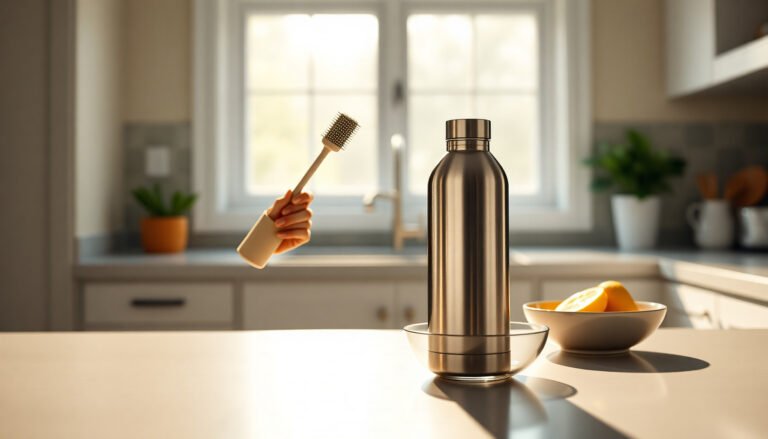
– Wash soon after use with warm water and mild dish soap; use a soft bottle brush if needed.
– Rinse thoroughly and let everything air-dry completely to prevent lingering odors and residue.
– Avoid abrasive sponges, scouring powders, and harsh chemicals unless the manufacturer explicitly allows them.
For aluminum water bottles, the key is residue control. Warm water helps dissolve biofilm and drink film, while mild soap prevents detergent buildup that can later affect taste. If your bottle has any interior coating, gentle cleaning helps preserve the coating’s “barrier” function—coatings are often designed to slow flavor absorption and reduce corrosion, not to survive repeated high-heat detergent cycles.
In my own kitchen practice, I also keep drying simple: I place the lid parts (gasket, cap, and any internal valves) on a clean rack so the gasket stays fully ventilated. That extra step matters because trapped moisture around seals is one of the fastest ways to get musty odors.
How to prep the lid, cap, and gaskets
Hand-washing works best when you treat the lid as a separate system from the bottle body. Many lid leaks come from tiny misalignments, and dishwashers can subtly deform or reposition seals.
– Remove the lid components you can (gasket, cap, any small valves) and wash them separately.
– If the gasket is removable, wash it gently and let it dry fully before reassembly.
– Re-check that all parts sit correctly—misalignment is a frequent cause of leaks (even when the bottle itself is fine).
Think of the lid as three functions: (1) sealing, (2) pressure/flow control (like straws or valves), and (3) lid interface geometry. Aluminum water bottles may stay structurally fine after dishwasher exposure, but if the gasket’s seating surface is distorted by heat or detergent swelling, you’ll see leaks during normal use.
If you’re unsure how a gasket seats, take a quick photo before disassembly. That “documentation habit” takes seconds and prevents the most common hand-wash mistake: installing the gasket slightly twisted, which can still look correct until you tighten the cap.
What can go wrong in the dishwasher
Dishwashers can damage aluminum water bottles even when the bottle body is technically “metal safe.” The most common failures show up as cosmetic changes, seal problems, and taste/odor carryover from trapped residue.
– Finish changes: aluminum may dull, discolor, or develop spots/pitting over time, especially under heat and detergent exposure.
– Seal failure: warped or hardened gaskets can lead to leaks or poor pressure/fit.
– Odors or taste carryover: dishwasher detergent residue (or lingering smells) can affect the next refill.
These issues often happen gradually, which is why inspection is important. After several cycles, check the lid gasket for flattening or loss of elasticity, and inspect the lid rim for residue. I also recommend smelling the dry lid parts: if the gasket or cap smells “detergent-clean” or plasticky after washing, that’s a sign residue may be lingering in aluminum water bottles’ sealing geometry.
Dishwasher vs. hand-wash (quick decision)
Below is a structured comparison you can use as an operational rule when you’re managing multiple aluminum water bottles in a household or office.
| Factor | Dishwasher | Hand-wash |
|---|---|---|
| Best for bottle body (uncoated) | Sometimes, if labeled safe | Yes—lowest risk |
| Best for lid gaskets | Often no (heat + detergent aging) | Yes—control detergent contact time |
| Coating/liner protection | Higher degradation risk | Preserves barrier longer |
| Residue/taste carryover risk | Moderate (trapped detergent) | Lower with thorough rinsing |
| Leaking after cleaning | More likely over time | Less likely with correct reassembly |
| Time to clean | Fast once loaded | Takes longer, but predictable |
| Consistency across batches | Varies by cycle | Consistent and controllable |
Verdict: safest routine and who should skip the dishwasher
The safest routine is to treat aluminum water bottles as “hand-wash first” unless the manufacturer explicitly says dishwasher safe for both the bottle and lid components. As of 2026, most brand care instructions still recommend keeping gasketed lid systems out of the dishwasher because that’s where leaks typically start.
– Safest approach: assume “hand-wash only” unless the manufacturer clearly says dishwasher safe for both the bottle and lid parts.
– Skip the dishwasher entirely if your bottle has a gasket you can’t confirm is rated for it, an interior lining/coating, or any removable valves/straws.
– Downside to hand-washing: it takes a bit more time than dumping it on a rack—so it’s worth using a simple routine (rinse after use + quick wash) to stay on top of it.
To make this actionable, use a “best fit” decision table that mirrors how you’d manage cleaning risk across multiple bottles.
| Feature (what you care about) | Dishwasher approach | Hand-wash approach |
|---|---|---|
| Bottle body finish protection | Uncertain; depends on coating/finish claim | Better preserved with mild soap |
| Lid gasket longevity | Higher aging risk from heat + detergent | Lower risk; controlled detergent contact |
| Leak prevention | More likely after seal deformation | Improved with careful reassembly |
| Taste and odor carryover | Moderate; residue can linger in crevices | Lower with thorough rinsing |
| Risk of pitting or spotting | More likely over repeated cycles | Rare when using gentle cleaning |
| Cleaning speed for large batches | Faster upfront | Slower but consistent |
| Control over detergent strength | No—uses dishwasher detergent automatically | Yes—mild soap, rinsed immediately |
| Drying outcomes | Can trap moisture around gaskets | Better—air-dry time is controllable |
| How forgiving it is for user error | Less forgiving (misloading can cause damage) | More forgiving (you can correct while washing) |
| Fit with typical 2026 user habits | Works when manufacturer allows it | Works for most gasketed lids |
| Best For | Bottle bodies explicitly labeled dishwasher safe (and lid parts you can confirm) | Most aluminum water bottles with coated interiors or any gasket/O-ring sealing system |
As a “versus” call, use this simple test: if you can’t confirm dishwasher safety for the lid gasket and any internal valves, hand-wash the aluminum water bottle instead.
| Criteria | Dishwasher | Hand-wash |
|---|---|---|
| Manufacturer label present | Only safe if clearly stated | No label needed—lowest risk |
| Heat exposure | High; can reach sanitizing levels | Moderate; controlled by you |
| Detergent chemistry | Strong; longer contact in cycles | Mild; shorter contact time |
| Lid gasket aging | More likely over repeated runs | Reduced stress if dried well |
| Coatings/liners | May degrade faster | Gentler on barrier surfaces |
| Residue/taste carryover | Possible from detergent residue | Less likely with thorough rinsing |
| Odor persistence | Can happen if gasket stays damp | Usually improves with air-drying |
| Risk of leaks | Higher after seal deformation | Lower when parts are aligned correctly |
| Overall wear | Increases over time | Slower, more predictable wear |
| Convenience | High | Medium (but easy) |
| Verdict | Only use when both bottle and lid parts are explicitly dishwasher safe | Choose hand-wash for most aluminum water bottles with gaskets or coatings |
Quick scan checklist (save this):
| Check | Dishwasher OK? |
|---|---|
| Label/manual says “dishwasher safe” for both bottle and lid parts | Likely yes |
| Bottle has interior lining/coating or special finish | Usually no |
| Lid includes gasket/O-ring/valve/straw | Usually no |
| You notice pitting, seal wear, discoloration, or leaks | Stop using dishwasher |
Frequently Asked Questions
Are aluminum water bottles dishwasher safe?
Many aluminum water bottles are not recommended for the dishwasher because heat and harsh detergents can damage the finish and affect the bottle’s interior lining. If your bottle has a powder-coated exterior or an anodized finish, dishwasher cycles may cause fading, scratching, or corrosion over time. To be safe, check the manufacturer’s care instructions; when in doubt, hand-wash aluminum bottles to preserve both appearance and performance.
How should I clean an aluminum water bottle safely without damaging it?
Rinse the bottle right after use, then wash with warm water and mild dish soap using a soft brush or sponge. Avoid abrasive scrubbers that can scratch the surface, and don’t use bleach or strong acids that may react with aluminum. For best results, rinse thoroughly and let it air-dry completely to prevent lingering odors and moisture-related corrosion.
Why do some aluminum bottles develop a metallic taste after washing?
A metallic taste can happen if the interior coating is worn, scratched, or not properly protected, allowing aluminum to interact with water and cleaning residues. Dishwasher detergent and high heat can also accelerate coating breakdown, especially around the lid and seams. If your bottle is lined, stick to gentle hand-washing and consider replacing the bottle if the taste persists.
What’s the best way to remove odors or stains from an aluminum water bottle?
To remove odors, fill the bottle with warm water and a small amount of baking soda, then let it sit for a few hours before rinsing and washing gently. For stubborn stains, use a diluted baking soda paste and a soft cloth or non-abrasive sponge, then rinse well. Always air-dry the bottle completely, because trapped moisture can bring back smells.
Which aluminum water bottle features make it safer to wash and maintain?
Look for bottles with a fully sealed interior lining (like food-grade coating) and a well-fitted, replaceable lid gasket to reduce leaks and buildup. Anodized aluminum or high-quality powder-coat finishes are typically more durable, but they still aren’t guaranteed to be dishwasher safe. For aluminum water bottles, the safest routine is typically hand-washing, especially if you want to keep the bottle’s coating intact longer.
📅 Last Updated: November 25, 2026 | Topic: Are Aluminum Water Bottles Dishwasher Safe? What You Need to Know | Content verified for accuracy and freshness.
References
- aluminum leaching from aluminum cookware – Search Results – PubMed
- aluminum corrosion detergent alkaline solution – Search Results – PubMed
- https://en.wikipedia.org/wiki/Corrosion_of_aluminium
- Anodizing
- Guidelines for drinking-water quality, 4th edition
- https://www.epa.gov/ground-water-and-drinking-water/secondary-drinking-water-regulations
- https://eur-lex.europa.eu/eli/reg/2004/1935/oj
- https://scholar.google.com/scholar?q=aluminum+dishwasher+corrosion+water+bottle Google Scholar
- https://scholar.google.com/scholar?q=aluminum+leaching+from+containers+detergents Google Scholar
- https://scholar.google.com/scholar?q=aluminum+food+contact+migration+dishwasher Google Scholar