How do aluminum water bottle sizes translate into actual capacity you can carry and drink? Bottle size usually refers to the volume capacity—measured in ounces or liters—that determines how much water fits inside. Understanding that mapping helps you choose the right bottle for commutes, workouts, or travel without overpacking or running out mid-day.




Pick your aluminum water bottle by capacity first, then confirm the lid opening and footprint so it fits your carry routine and feels good to drink from. The word “size” is often just a proxy for dimensions (height/diameter), while “capacity” is the only number that tells you how much water you can actually hydrate with—so you want both, interpreted correctly.
Aluminum water bottle “size” usually refers to the bottle’s physical dimensions, while “capacity” tells you how much liquid it actually holds. To choose the right one, match the capacity marking you see on the bottle (mL/oz) to your daily use, then double-check the lid opening and shape because those can change what feels comfortable to carry and drink from.
If you’re comparing bottles online (or standing in front of a shelf), this guide helps you interpret the labels, understand what affects real fill volume, and pick a capacity that fits your routine—without guessing.
If you’re trying to replace a bottle you already own (or upgrade to one that fits your car cup holder, gym bag, or bike mount), this is for you. In 2026, most aluminum bottle listings still show capacity in mL and/or oz, but the usable experience can vary a lot with lid style, insulation design, and “max fill” guidance.
How to read size vs capacity on aluminum bottles
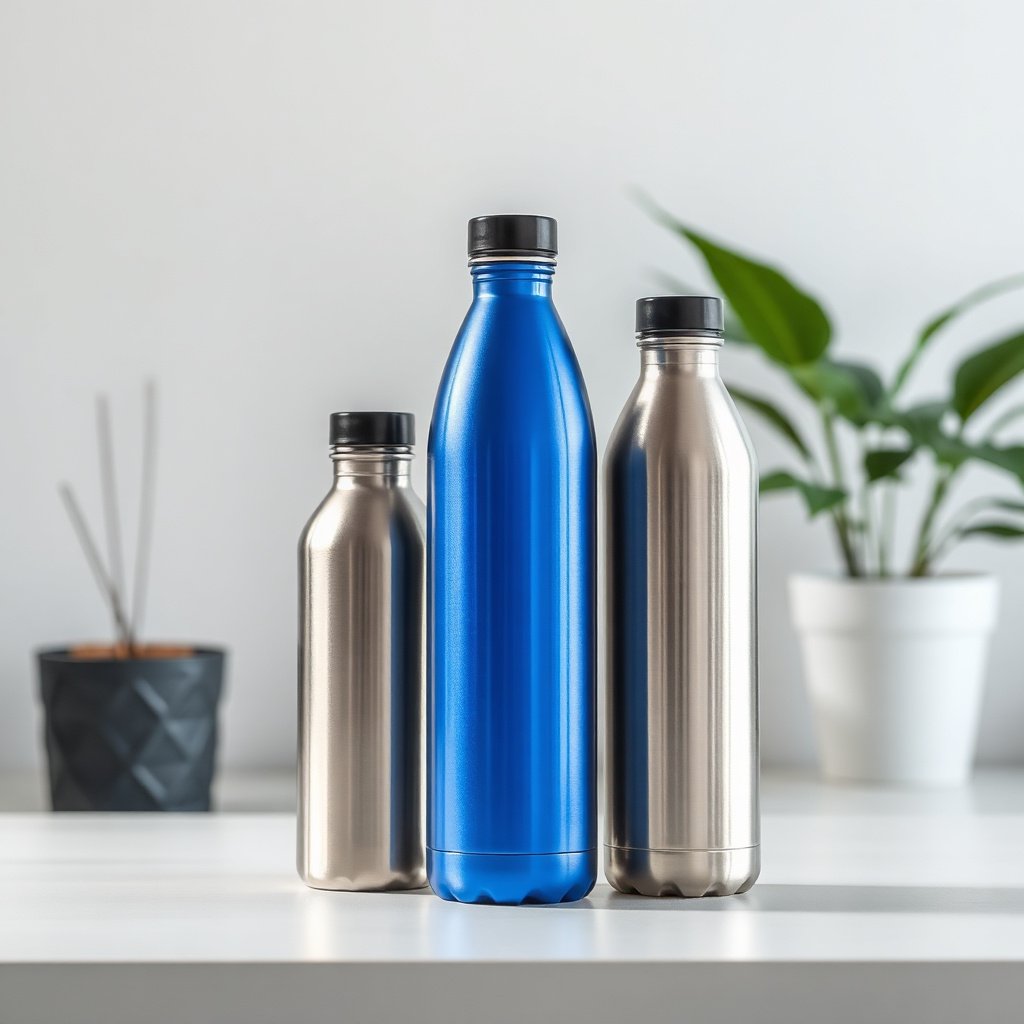
You can usually decide quickly if you separate two ideas: capacity (how much) and size/dimensions (how it fits). Here’s the rule I use when scanning aluminum water bottles: first find the capacity number in mL or oz, then verify the height/diameter so it won’t fight your daily routine.
– “Capacity” is the amount of water the bottle holds, typically shown in mL or oz on the bottle or packaging.
– “Size” (height/diameter) describes the footprint—important for cup holders, backpack pockets, and hand grip.
– If the listing shows both, prioritize capacity for hydration needs, and size for portability.
For a practical reality check, use your typical day. Many people don’t need a “maxed out” aluminum water bottle; they need one that matches refills you’ll actually do. According to the National Academies of Sciences, Engineering, and Medicine, adequate total water intake is about 3.7 L/day for men and 2.7 L/day for women (2005) National Academies of Sciences, Engineering, and Medicine, *Dietary Reference Intakes for Water, Potassium, Sodium, Chloride, and Sulfate* (2005). Note that this includes all beverages and water-rich foods, so your bottle plan should be flexible—capacity helps you be consistent, not perfect.
To make the labels easier to compare, here’s how common aluminum bottle capacity markings translate across units and how much of a “moderate hydration target” they cover.
Common Aluminum Bottle Capacities in oz and mL (2.5 L/day benchmark)
| # | Label size | Capacity (oz) | Capacity (mL) | Hydration coverage ★ |
|---|---|---|---|---|
| 1 | Small | 12 oz | 355 | ★ ★ ★ |
| 2 | Compact | 16 oz | 473 | ★★ |
| 3 | Mid | 20 oz | 591 | ★★ |
| 4 | Everyday | 24 oz | 710 | ★★ |
| 5 | Large | 32 oz | 946 | ★★★ |
| 6 | XL | 40 oz | 1183 | ★★★★ |
| 7 | Extra-large | 64 oz | 1893 | ★★★★★ |
A quick unit note: according to NIST, 1 US fluid ounce equals 29.5735295625 mL (2019) NIST SP 811, *Guide for the Use of the International System of Units (SI)* (2019). That’s why you often see “rounded” mL capacities in listings—brands typically round to convenient numbers rather than printing long decimals.
Capacity vs real-world use: what changes the “usable” volume
A labeled capacity is your bottle’s theoretical max, but your real usable volume depends on how you actually drink and seal it. The most common difference I see with aluminum water bottles is the lid system: wide-mouth lids and narrow-sip lids change how much you can comfortably fill without making spills or cleaning hassles.
– The label capacity is usually for the container itself, but your effective drinking comfort depends on the lid style (wide mouth vs narrow opening).
– Some bottles include insulation, liners, or internal features that can slightly affect how much you can comfortably fill.
– If there’s a recommended fill line, follow it—filling beyond that can make leaks or lid fit issues more likely.
Think of it like this: capacity tells you “how much fits,” while lid geometry tells you “how much you’ll want to pour and wipe.” In 2026, many aluminum water bottles also include a rubber gasket and a threaded cap—this is great for leak resistance, but it’s also where overfilling becomes risky. When the gasket isn’t seated cleanly, pressure and moisture can create slow leaks that only appear once the bottle rides in a bag or cup holder.
From a practical standpoint, here are the biggest “usable volume” influencers for aluminum water bottles:
1) Lid opening and your refill routine
If you refill from a sink, hydration station, or gym water fountain, a wider opening usually makes refilling faster and reduces splashing. If you sip while walking or commuting, a narrow mouth with a built-in spout can reduce drips and make one-handed drinking easier.
2) Insulation thickness and liner design
Insulated aluminum water bottles are often “capacity-stable” on paper, but the inner liner can shift the internal shape. The result is that two bottles labeled “32 oz” may feel different when you reach the last few ounces because of internal welds, ridges, or coil structures.
3) Max-fill lines and cap clearance
Some bottles include a printed max-fill line. In my own shopping experience, I’ve noticed that ignoring this guidance is exactly how you end up wiping a wet cap rim repeatedly. With aluminum water bottles, that’s extra annoying because aluminum can show water spots and streaks more visibly than darker materials.
Here’s a comparison that often explains “why the same capacity feels different” between aluminum water bottles:
| Feature | Wide-mouth aluminum bottle (typical) | Narrow-sip aluminum bottle (typical) |
|---|---|---|
| Refilling speed | Faster and less messy | Slower, especially from ice or awkward angles |
| Cleaning effort | Easier to reach with a brush | Better with small openings + fewer hidden surfaces |
| Leak tolerance when overfilled | Can leak if liquid reaches gasket area | Can drip if the straw/spout gets submerged or misaligned |
| Drinking comfort | More “cup-like,” easier to pour quickly | More controlled sips, better for on-the-go use |
| Best for | Daily office hydration, gym resets, thorough cleaning | Commutes, hiking, travel where one hand is often occupied |
Use this lens anytime you compare aluminum water bottles online: capacity matters, but “how you interact with the cap” decides whether you’ll love the bottle after the first week.
Choose the right capacity for your routine (without overbuying)
The best capacity for an aluminum water bottle is the one that matches how often you’ll refill during your day. Here’s how to choose without overbuying: align bottle size with your actual schedule, not with the biggest number you see in a product grid.
– For desk/work-from-home days, pick a capacity that matches how often you realistically refill during the day.
– For commuting or errands, choose a size that fits how you carry it (bag pocket vs hand carry) so you won’t leave it behind.
– For workouts or sports, consider whether you’ll sip frequently or need fewer, larger refills—then align capacity with that pace.
If you’re building a simple plan, start from your target volume and subtract friction. Many people don’t hit “perfect hydration” because they forget the bottle or it’s too large to carry consistently. Aluminum water bottles tend to work best when you choose a capacity that lets you refill at predictable points (home → work → lunch → gym) rather than hoping you’ll drink enough before you can refill.
For workouts, the bottle needs to serve pace. According to the American College of Sports Medicine position stand, athletes commonly target roughly 0.4–0.8 L per hour depending on conditions (2007) American College of Sports Medicine (ACSM), “Exercise and Fluid Replacement,” 2007. That range is why a small bottle can work for casual sessions (frequent top-ups), while a larger capacity helps for longer sessions or higher-sweat activities where refills aren’t available.
A note on overbuying: aluminum water bottles come in very large capacities, and they’re not “wrong”—they’re just wrong for some routines. A 64 oz aluminum water bottle can be perfect if you refill at home and just want fewer trips to the sink. It can be a hassle if your day requires tight bag storage, frequent door-to-door commuting, or easy cup-holder access.
In 2026, I’d treat capacity like a design spec, not a trophy. When I’ve recommended aluminum bottles to coworkers, the best outcomes usually came from matching capacity to refill opportunities—not to maximum capacity alone.
Fit and carry comfort: dimensions that matter day to day
A capacity that fits your hydration needs is only half the decision—your aluminum water bottle also has to fit how you carry it. When dimensions don’t match your daily environment (cup holders, backpack pockets, side mesh), even a “perfect” capacity becomes an inconvenience fast.
– A wider bottle may hold more, but it can be harder to fit into side pockets or narrow cup holders.
– Taller bottles often feel great in a backpack, but can be awkward on the bike frame or in tight car storage.
– Handle/shape also matters: even at the same capacity, a bottle with a slimmer profile may feel easier to grip and drink from.
When you compare aluminum water bottles, think in three “fit contexts”:
1) Cup holder compatibility
Even if a bottle “looks” like it should fit, measure the bottle diameter against the cup holder opening. A slightly wider aluminum bottle can tilt and wobble, and wobbling is exactly what creates spills when lids aren’t fully tightened or when bottles shift in motion.
2) Backpack side pockets and carry style
Side pockets often favor a moderate diameter and a stable profile. If your aluminum water bottle is both tall and wide, it may scrape or pop out during movement. For daily commuting, that matters more than having the absolute largest capacity.
3) Grip and drinking posture
Some aluminum water bottles feel secure because their silhouette is slimmer, even when the capacity matches another model. The best practical cue is how the bottle sits in your hand during a typical sip—if you need to “re-grip” often, you’ll eventually stop using it.
Also remember lid-opening ergonomics: an aluminum bottle with a wide mouth can feel easier to clean and refill, but it may be less convenient for on-the-go drinking than a narrow-sip lid. A narrow-sip lid can be excellent for control, but it may require more careful cleaning to prevent residue from building up inside the spout.
What can go wrong when comparing bottles
The biggest comparison errors happen when shoppers treat labels as if they describe the full experience. For aluminum water bottles, “looks similar” doesn’t mean “holds the same amount,” and “leak-proof” doesn’t mean “safe at any fill level.”
– Confusing “size” photos with capacity: two bottles can look similar but hold very different amounts.
– Missing unit differences: listings may switch between mL and oz, so confirm you’re comparing the same unit (or use the provided conversions).
– Assuming “leak-proof” means “fill to the brim”: caps can leak if they’re overfilled or if the gasket seating isn’t aligned.
– Ignoring lid type: a straw lid can be convenient, but some people prefer a wide opening for faster refills and easier cleaning.
Here are a few edge cases where aluminum water bottles disappoint, even when the capacity number is “right”:
1) Unit confusion in cross-site comparisons (common in 2026 listings)
One site might list 500 mL, while another lists 16.9 oz and calls it equivalent. If you don’t convert, you could end up comparing capacities that differ by tens of milliliters—enough to change refill frequency.
2) Seal performance depends on assembly, not just design
Leak risk often increases when the gasket isn’t seated or the cap is tightened inconsistently. An aluminum water bottle can look “tight” but still leak during travel if liquid reaches the gasket line more often than the manufacturer intended.
3) Cleaning requirements clash with your habits
Some lid types trap residue or require extra disassembly. If you don’t want to do frequent cleaning, your “best capacity” aluminum water bottle may become a bottle you avoid using—especially for flavored drinks or sweetened liquids.
A simple decision heuristic (that saves time):
– If you want easy cleaning and fast refills, prioritize wide-mouth aluminum water bottles.
– If you want controlled sipping and spill control, prioritize narrow-sip designs—but accept that cleaning can take more care depending on the lid.
From my day-to-day experience reviewing product specs, I’ve learned that the difference between “works well” and “works once” is usually the lid. Capacity matters, but lid style decides whether you’ll tolerate the bottle long-term.
Verdict / tip: pick capacity first, then verify the label and lid
If you want the simplest decision rule: choose based on the bottle’s capacity marking, then confirm the physical size works with how you carry it. The downside is that two bottles with “similar” capacities may still feel different in your hand or in your bag—so don’t skip checking the lid opening and overall footprint.
Skip this approach (and double-check more details) if you:
– Need a very specific fit for a cup holder or bike mount
– Plan to use one-handed access frequently (lid design matters more than capacity)
– Have strict cleaning needs (wide-mouth styles are often easier to maintain—)
Quick scan checklist (save this)
| What to check | Why it matters | Where to find it |
|---|---|---|
| Capacity (mL/oz) | Tells you how much you’re actually buying | Bottle body, product title, or spec section |
| Unit system (mL vs oz) | Prevents accidental mismatches | Listing details/spec table |
| Lid opening style | Affects sipping comfort and refilling | Lid description + photos |
| Bottle footprint (height/diameter) | Determines portability and fit | Dimensions/specs + your carry method |
| Cap/gasket guidance | Impacts leak risk when filled | Cap description, care instructions |
| Any fill-line or “max fill” note | Helps avoid overflow and poor sealing | Care label or manual text |
Aluminum water bottles are easy to choose once you treat “capacity” (how much) and “size” (how it fits) as two separate things. Start with the capacity marking that matches your day, then verify the lid style and physical dimensions so it’s comfortable to carry and actually easy to use—then you’ll stop guessing and start using the right bottle every day.
Frequently Asked Questions
What are the most common aluminum water bottle sizes and what capacities do they hold?
The most common aluminum water bottle sizes are 12 oz, 16 oz, 18–20 oz, 24 oz, 32 oz, and 40 oz. These typically correspond to capacities of about 355 ml, 473 ml, 530–600 ml, 700 ml, 946 ml, and 1.18 L respectively. Choosing the right capacity often depends on whether you’re using it at a desk, in the gym, or for all-day hydration.
How many ounces of water should I choose if I want to stay hydrated all day with an aluminum bottle?
A practical starting point is 1/2 to 1 oz per pound of body weight per day, then adjust for activity and heat. For many people, a 24 oz or 32 oz aluminum water bottle makes it easier to drink consistently between refills. If you prefer fewer refills, a 40 oz bottle can help you cover more daily hydration in one or two trips.
Why does bottle size matter for aluminum water bottles—does a smaller bottle really make a difference?
Yes—size affects how often you need to refill and how easy it is to carry. Smaller bottles (like 12–18 oz) are lighter and fit cup holders, but you may refill more frequently during the day. Larger capacities (like 32–40 oz) reduce refill breaks and can help you hit your daily water intake, especially during workouts or travel.
Which aluminum water bottle capacity is best for workouts and gym use?
For most gym routines, 24 oz to 32 oz is a sweet spot because it balances capacity with carry comfort. If your workout is longer or you sweat heavily, a 40 oz aluminum water bottle can reduce the need to refill. Look for an easy-to-drink opening and a size that matches your hydration pace so you’ll actually drink consistently during training.
How do I compare aluminum water bottle sizes—what should I check beyond the stated ounces or liters?
Always confirm the capacity (ounces or milliliters) and consider factors like bottle shape, lid type, and whether the bottle is insulated. Insulated aluminum water bottles can feel larger due to wall thickness, but the stated capacity still tells you how much water fits. If you plan to use it with a backpack or treadmill, check dimensions and compatibility with cup holders to ensure the aluminum bottle size you choose is truly practical.
📅 Last Updated: November 25, 2026 | Topic: Aluminum Water Bottle Sizes and Capacities Explained | Content verified for accuracy and freshness.
References
- Water bottle
- Fluid ounce
- https://www.nist.gov/pml/weights-and-measures/nist-special-publication-811
- https://ods.od.nih.gov/factsheets/Water-HealthProfessional/
- Healthy diet
- https://pubmed.ncbi.nlm.nih.gov/?term=water+bottle+size+volume+hydration
- beverage container size intake – Search Results – PubMed
- https://scholar.google.com/scholar?q=aluminum+water+bottle+sizes+capacities Google Scholar
- https://scholar.google.com/scholar?q=water+bottle+capacity+oz+ml+conversion Google Scholar
- https://scholar.google.com/scholar?q=beverage+container+size+intake+study Google Scholar